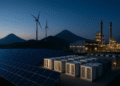



We’re watching the biggest shift in power production since electricity first lit up a lightbulb. What’s wild is this: the winners of this shift aren’t just the big utilities or billion-dollar energy developers. The winners include farmers, ranchers, landowners, and everyday entrepreneurs who suddenly find themselves holding the most valuable commodity in the clean-energy economy—land in the right place at the right time.
While the headlines obsess over solar megaprojects, towering wind farms, or the next hydrogen hype cycle, the real quiet revolution—the one with the strongest financial punch—is utility-scale energy storage. The future grid runs on electrons, but it survives on batteries. And those batteries need land, partnerships, and long-term leases that can make property owners rich for decades.
This is the kind of moment that Positive Phil loves: optimism backed by innovation, opportunity backed by economics, and real wealth backed by megawatt-hours.
Let’s dive deeper into why utility-scale battery storage is becoming the new gold rush.
Utility-Scale Battery Storage Is Exploding — and It’s Not Slowing Down
A modern grid cannot survive on “just-in-time” electricity anymore. Solar floods the system at noon. Wind roars at night. Humans, being the unpredictable creatures we are, crank up demand whenever it suits us. The old balancing act no longer works.
So the grid needs warehouses of electricity—big, industrial-scale repositories of energy that can catch excess power and release it when demand surges. Utility-scale BESS (Battery Energy Storage Systems) do exactly that.
Everything is converging to make this sector explode. Battery prices continue to fall. Government incentives are pouring fuel on the fire. Utilities are literally begging for new storage to stabilize renewable-heavy grids. Developers are racing to secure land the same way prospectors once rushed to California creeks with pans in their hands. Private equity funds are scooping up battery projects faster than local permitting offices can process paperwork.
This isn’t hype. This is infrastructure. It’s the foundation of the next 50 years of American energy.
And because batteries can be built on smaller footprints than solar or wind, the land underneath these projects is suddenly more valuable than corn, cattle, timber, or practically any traditional land use.
Landowners Across the Country Are Becoming Energy Tycoons
If you own acreage in states like Texas, Arizona, California, Florida, Nevada, Georgia, Colorado, or anywhere near the growing transmission corridors across the Midwest, you may be sitting on a quiet fortune.
Developers need land more than anything else. Not subsidies. Not government guarantees. Not ideal weather conditions. They need land with proximity to substations, transmission lines, access roads, and the ability to get permits. If your land checks those boxes, developers will come knocking.
And what they offer is transforming rural economies.
Instead of farming, grazing, or building, landowners are leasing their properties for 20, 30, sometimes 40 years to battery developers. These leases can pay anywhere from $1,000 to over $6,000 per acre per year, with annual escalators to keep pace with inflation. No irrigation. No drought losses. No crop failures. No tractors, no fertilizer, no cattle vaccinations. Just clean, consistent, long-term income—often secured by publicly traded companies or large energy funds.
For many families, this income means stability across generations. It’s turning modest landowners into long-term passive-income earners with revenue streams smoother than the stock market.
The gold rush is real. And unlike past booms, this one is quiet, clean, stable, and long-lived.
Investors See the Writing on the Wall — and They’re Pouring In
You can tell where the smart money is flowing by watching the companies building the backbone of this new ecosystem.
Utility-scale energy storage is a dream scenario for investors. It produces predictable multi-decade cash flow. Operational costs are low. Battery farms earn revenue from price arbitrage—buy cheap electricity at night, sell expensive electricity during peak hours—plus payments for grid services like frequency regulation, capacity stabilization, and backup support.
The Inflation Reduction Act turned battery storage into a tax-credit machine, making projects even more attractive. Suddenly battery farms aren’t just infrastructure—they’re financial assets. They operate almost like annuities powered by electrons.
Institutional capital knows this. Hedge funds know it. Large utilities know it. This is why nearly every major player in energy finance is building a storage portfolio right now. The momentum is unstoppable.
The Public Companies Quietly Winning This Race
Utility-scale storage used to be niche. Now it’s dominated by companies that are shaping the future grid.
Tesla is deploying Megapacks so quickly that entire utilities are ditching gas peaker plants in favor of battery farms. Fluence is capturing global bids with some of the largest storage deployments on the planet. Stem Inc. is integrating AI optimization into large-scale storage networks. NextEra is stacking massive solar + storage projects across the nation, basically rewriting how grid capacity is built. AES is partnering with governments and industrial giants to stabilize entire regions with batteries. Even companies like Constellation and Generac are evolving into energy-resilience providers for commercial and industrial customers.
These aren’t speculative ventures. These are durable, infrastructure-focused businesses. And they may represent one of the strongest long-term megatrends in the market.
The Hidden Wealth Multiplier Almost Nobody Talks About
Storage alone is powerful, but the real wealth multiplier is storage + solar + tax credits, aligned with the right land.
Battery projects now qualify for the 30% federal Investment Tax Credit, plus bonus credits for domestic content, energy communities, and low-income zones. When developers combine these incentives with long-life land leases, the economics get almost irresistible.
Utility-scale storage is becoming the clean-energy version of commercial real estate: high cash flow, rising demand, scarcity of great sites, and deep-pocketed investors hungry for long-term returns. Except unlike commercial buildings, batteries don’t require tenants, maintenance issues, repairs, or market cycles.
This isn’t a bubble. It’s a structural shift in how America powers itself.
Why Positive Phil Loves This Sector (and Why You Should Too)
There’s something deeply inspiring about watching landowners, families, and small communities step into the center of a national energy transformation. Utility-scale battery storage isn’t just about technology—it’s about opportunity. It’s about new income streams in rural towns. It’s about optimism for a cleaner and more resilient grid. It’s about the chance for everyday landowners to become part of the new energy aristocracy.
You don’t need oil wells.
You don’t need a coal seam on your property.
You don’t need a wind corridor or a desert of sunshine.
You just need land, timing, and the willingness to step into the future.
Utility-scale storage is a wealth engine disguised as a cluster of metal containers filled with lithium cells and power electronics. But those containers can change the financial trajectory of a family. They can fuel investment, create new industries, and stabilize grids for decades.
This is optimism you can bank on—literally.
The Takeaway: We Are Witnessing the Biggest Wealth Transfer in Energy Since Shale
Utility-scale battery storage is doing for landowners what shale did in the 2000s—but with none of the pollution, political battles, or boom-and-bust cycles. It’s cleaner, steadier, and built for the long game.
If you’re an investor, follow the companies building America’s battery spine.
If you’re a landowner, understand that your acreage may carry more value than you ever imagined.
And if you’re a believer in optimism and opportunity like Positive Phil, recognize that this moment—right now—is one of the greatest chances in modern history to tap into the energy transition in a way that uplifts everyone involved.
The gold rush is here. It’s just electric.