


Long-Duration Energy Storage: The Next Trillion-Dollar Infrastructure Build in America
For most of the past decade, the conversation around renewable energy has been dominated by solar and wind deployment. Panels got cheaper. Turbines got bigger. Capacity exploded.
But something quietly became obvious along the way.
Generating cheap electricity is no longer the hard part.
The real challenge is when that electricity shows up and whether it can be delivered when the grid actually needs it.
This is where energy storage — particularly long-duration, front-of-the-meter storage systems — becomes one of the most important infrastructure investments the United States will make over the next 30 years.
We’re entering the early innings of a market that could easily surpass $1–2 trillion in total infrastructure investment globally.
And unlike previous clean energy trends, storage is not just about decarbonization.
It’s about grid reliability, national energy security, market stability, and massive capital deployment.
The Grid Problem Nobody Talks About Enough
The U.S. electric grid was designed decades ago around a simple assumption:
Electricity generation follows demand.
Coal plants, gas plants, and nuclear facilities were dispatchable. Operators could ramp them up or down depending on how much power consumers needed.
Renewables flipped that model.
Solar produces electricity when the sun shines.
Wind produces electricity when the wind blows.
Neither cares about peak demand.
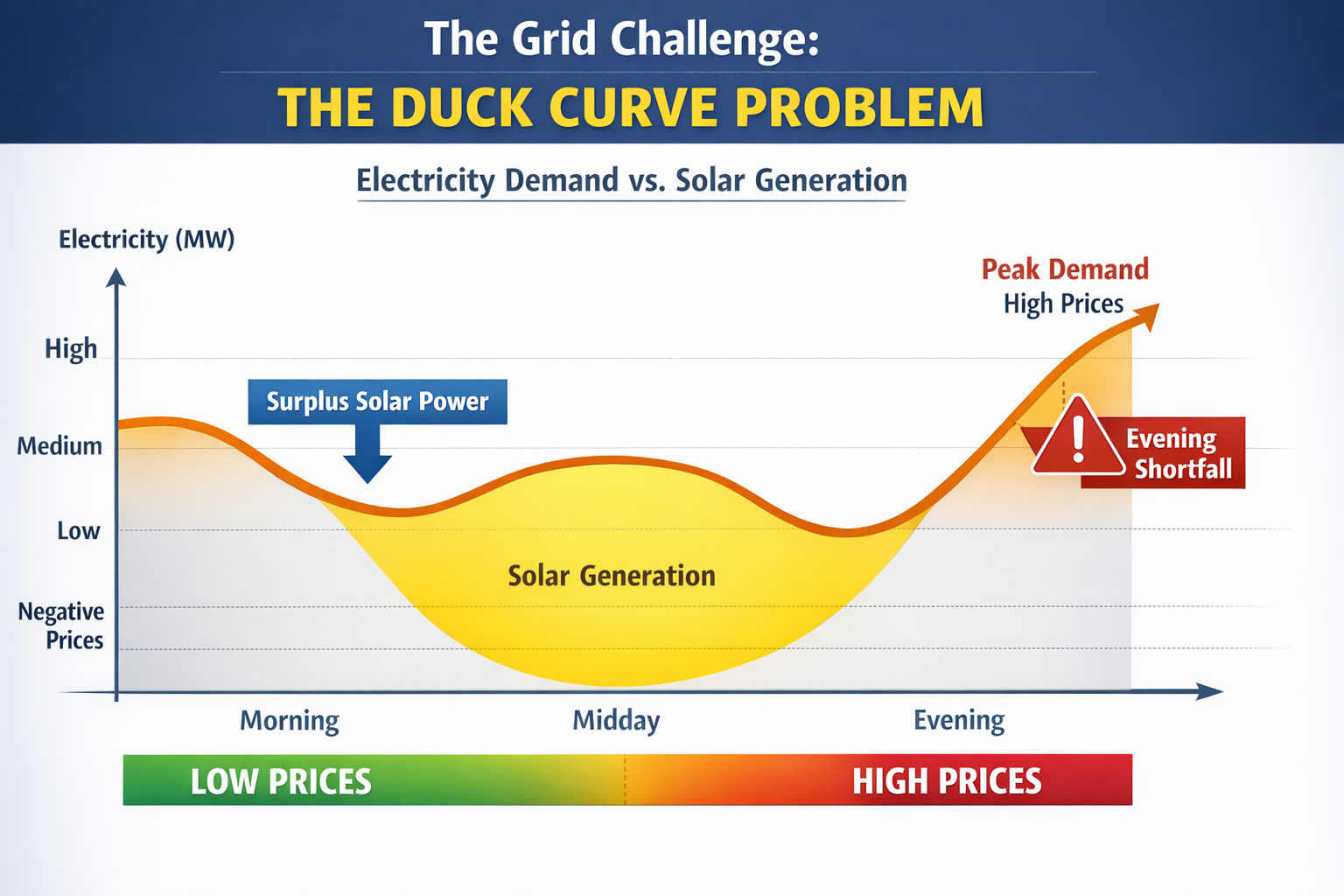
That mismatch has created the now-famous duck curve, particularly visible in California and increasingly across other markets.
The Duck Curve Problem
Electricity Demand vs Solar Generation
Demand
^
| /\ Peak demand (evening)
| / \
| / \
| / \
| / \
| / \
| / \____
| / \____
|_____/__________________________> Time
Morning Midday Evening
Solar Generation
_________
/ \
/ \
_____/ \_____
At midday, solar floods the grid with cheap electricity. Prices collapse. Sometimes they even go negative.
By early evening, solar disappears while demand surges.
Grid operators suddenly need massive amounts of power — fast.
Historically that gap was filled by natural gas peaker plants.
But that solution has limits.
Peaker plants are expensive to run, politically contentious in many regions, and slow to permit.
Energy storage changes the equation.
Instead of generating electricity exactly when it’s needed, the grid can store excess energy and deploy it later.
That sounds simple. But at grid scale, it becomes a massive engineering and capital problem.
Front-of-the-Meter Storage: A New Infrastructure Asset Class
Energy storage projects generally fall into two categories.
Behind-the-Meter Storage
Installed at commercial facilities, factories, campuses, or homes.
These systems reduce electricity bills, avoid demand charges, and provide backup power.
Front-of-the-Meter Storage
Installed directly on the grid at utility or transmission scale.
These projects participate in wholesale electricity markets.
They can provide:
• Energy arbitrage
• Capacity market participation
• Frequency regulation
• Spinning reserve
• Black start capability
• Transmission congestion relief
• Renewable firming
Front-of-the-meter storage is where the big infrastructure capital is flowing.
Think projects in the range of:
• 100 MW
• 500 MW
• 1 GW+
These systems often sit adjacent to large solar or wind projects, transmission nodes, or constrained grid regions.
The Lithium-Ion Era (And Its Limits)
Most energy storage deployed today uses lithium-ion battery technology, similar to electric vehicle batteries.
Lithium-ion systems have several advantages:
• Mature supply chains
• High energy density
• Rapid response time
• Declining costs due to EV scale
Typical grid batteries today offer 4 hours of discharge duration.
That means a 100 MW battery can deliver:
For many applications, four hours works.
It smooths solar output and helps bridge early evening demand spikes.
But as renewable penetration increases, grid operators are discovering something important.
Four hours often isn’t enough.
Why the Future of Storage Is Longer Duration
Imagine a region heavily powered by solar.
A cloudy day rolls through.
Solar production collapses.
Demand remains high.
A four-hour battery runs out quickly.
Now imagine a multi-day weather system reducing wind output across an entire region.
Europe experienced this during several “wind droughts.”
The U.S. grid will face similar scenarios.
What the grid increasingly needs is storage capable of delivering power for 10, 20, or even 100 hours.
This is what the industry calls:
Long-Duration Energy Storage (LDES)
The Department of Energy typically defines LDES as storage capable of 10+ hours of discharge.
But many technologies being developed go far beyond that.
Long-Duration Storage Technologies Emerging Today
Several competing technologies are racing to scale.
Each takes a very different approach to storing energy.
Iron-Air Batteries
One of the most talked about innovations comes from Form Energy, backed by major utilities and investors.
The system uses a simple chemical reaction:
Iron + Oxygen = Rust
When electricity is available, the battery converts rust back into iron.
When energy is needed, the iron oxidizes again, releasing electricity.
The result is a system capable of up to 100 hours of storage.
The materials involved are cheap and abundant.
Iron is one of the most widely available elements on Earth.
Flow Batteries
Flow batteries store energy in large tanks of liquid electrolytes.
Instead of storing energy in solid electrodes like lithium batteries, flow systems separate the power component from the energy storage component.
This allows duration to be increased simply by adding larger tanks.
Flow Battery Concept
Power Stack
||
||
||
[ Electrolyte Tank ] —- Pump —- [ Electrolyte Tank ]
Energy Storage
Advantages include:
• Long cycle life
• Scalable duration
• Low degradation
The most well-known chemistry is vanadium redox flow batteries.
Compressed Air Energy Storage (CAES)
Another approach stores energy using compressed air stored underground.
Excess electricity compresses air into underground caverns.
When power is needed, the compressed air is released through turbines to generate electricity.
|
|
Release Air
|
v
Turbine
|
v
Electricity
Some systems can store energy for days or weeks.
Thermal Storage Systems
Thermal systems store energy as heat.
Electricity heats materials such as molten salt, bricks, or other mediums.
Later the heat is converted back into electricity via steam turbines or other mechanisms.
Thermal storage can potentially scale very cheaply because the materials involved are inexpensive.
Hydrogen as Long-Duration Storage
Hydrogen is another major pathway.
Excess renewable electricity powers electrolyzers, splitting water into hydrogen and oxygen.
The hydrogen can then be stored and later used in:
• Gas turbines
• Fuel cells
• Industrial processes
Hydrogen storage could potentially provide seasonal energy storage, something batteries cannot easily achieve.
Why Investors Are Suddenly Paying Attention
Energy storage is becoming one of the most attractive sectors for infrastructure capital.
The reason is simple.
Storage assets can generate revenue in multiple ways simultaneously.
This concept is known as revenue stacking.
Example Revenue Stack
Battery Storage Project
Revenue Streams
————————-
Energy Arbitrage
Capacity Payments
Frequency Regulation
Transmission Support
Resource Adequacy
Black Start Services
A single asset might earn money from several markets at once.
This makes storage increasingly attractive to:
• Infrastructure funds
• Pension funds
• Sovereign wealth funds
• Utilities
• Private equity
The Massive Financing Opportunity
The U.S. will likely need hundreds of gigawatts of energy storage to support the future grid.
Consider this.
The United States currently operates roughly:
• ~1,200 GW of generation capacity
If renewable energy grows to supply the majority of electricity, analysts estimate the grid may require 20–40% storage capacity relative to renewable generation.
That implies hundreds of gigawatts of storage capacity.
At current installation costs, this translates into hundreds of billions of dollars in capital investment.
Some projections suggest the global storage market could exceed:
$1 trillion by 2040.
Federal Policy Is Accelerating the Market
The Inflation Reduction Act dramatically improved storage economics.
For the first time, standalone energy storage projects qualify for the Investment Tax Credit (ITC).
Developers can receive tax credits covering roughly:
30–50% of project capital costs
depending on bonus qualifications.
This single policy change unlocked billions in new project development.
Where the First Major Storage Markets Are Emerging
Several regions are becoming hotspots for storage deployment.
California
The largest storage market in the United States.
Driven by aggressive renewable targets and grid reliability needs.
Texas (ERCOT)
A merchant storage boom is underway due to volatile power prices.
Arizona
Rapid solar growth is creating massive storage demand.
New York
State mandates require several gigawatts of storage deployment.
PJM Interconnection
Capacity markets could drive future storage expansion.
The Hidden Role Storage Will Play in Energy Security
Energy storage is not just a renewable integration tool.
It is becoming a national security asset.
Modern economies depend on reliable electricity.
Power disruptions impact:
• Manufacturing
• Data centers
• Hospitals
• Transportation
• Defense infrastructure
Large-scale storage can provide resilience against:
• Extreme weather
• Grid disruptions
• Cyber threats
• Fuel supply interruptions
In a world where geopolitical tensions affect energy markets, storage provides strategic flexibility.
What Happens When Storage Truly Scales
When storage becomes abundant, the electricity system begins to change fundamentally.
Prices stabilize.
Renewables become dispatchable.
Gas peaker plants become less necessary.
Transmission congestion decreases.
And the grid becomes far more resilient.
In many ways, storage transforms intermittent renewables into firm power resources.
That changes everything.
The Bigger Picture
Energy storage is still early.
Solar went through the same phase 15 years ago.
At first it was expensive, experimental, and niche.
Then manufacturing scaled.
Costs collapsed.
Deployment exploded.
Storage is following a similar path.
Over the next two decades, we will likely see:
• Massive technology innovation
• Rapid cost reductions
• Gigawatt-scale deployments
• Entirely new grid operating models
What’s unfolding is not just a new technology cycle.
It’s the early stages of a fundamental redesign of how electricity systems operate.
And long-duration energy storage will sit right at the center of it.